Monthly Archives: April 2008

ACID Test-like for Mobile Web Browsers

The “Mobile Web Test Suites Working Group“, a W3C group whose goal is to provide test suites for mobile Web technologies just recently announced the launch of its “Web Compatibility Test for Mobile Browsers”.

In the same spirit as the well known ACID tests for desktop Web browsers, the Web Compatibility Test for Mobile Browsers (no, they couldn’t find a better name :)) allows to test 12 Web technologies “ranging from well-deployed (but often poorly implemented on mobile devices) technologies such as HTTPS and PNG, to technologies we believe will matter in a year or two (like SVG animation and CSS Media Queries).”

To perform the test, you need to point your mobile web browser to this URI: http://dev.w3.org/2008/mobile-test/test.html or this one (shorter): http://tinyurl.com/37e33p

Each technology is represented by a square, if the technology is supported, the square will be green.
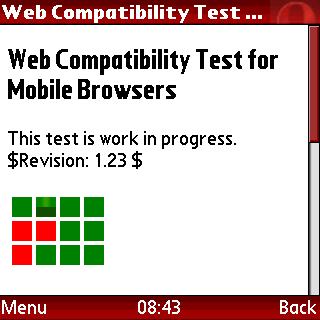
Opera mini 4.1 test

Test of Opera Mini 4.1

As more and more people go online from their mobile devices, this test will help decide if the browsers installed on their phones can provide them with the most enjoyable experience.

That’s really a nice move from the W3C. More information here .

Enkin: Revolutionary GPS Application for Android

If you take two Computational Visualistics students, give them Google Android’s SDK and motivate them with a $275.000 award , you’ll get Enkin, a revolutionary handheld navigation concept.

Here is how Enkin’s creators present it:

“Enkin” introduces a new handheld navigation concept. It displays location-based content in a unique way that bridges the gap between reality and classic map-like representations. It combines GPS, orientation sensors, 3D graphics, live video, several web services and a novel user interface into an intuitive and light navigation system for mobile devices.

What makes Enkin so unique is that it has as “live mode”, meaning that for example when pointing your phone camera towards a building that is in fact an hospital, the interface will indicate so.

The user interface has three different modes:

– Map mode: This is a two-dimensional mode and similar to
classical maps applications. It provides a quick overview of
all active location-based content and lets you easily manage
your data.

– Landscape mode: This mode resembles loosely Google
Earth’s 3D view. It enables your content’s third dimension
by embedding it into a three-dimensional landscape.

– Live mode: This acts as the bridge to reality. Now your content
is displayed extending real physical objects instead of
computer graphics by using the device’s built-in camera.

Watch their video here to see it in action.

Phones equipped with Android haven’t hit the market yet, so when this happens, Enkin will be more impressive than when used from an emulator.

Android proves that it will truly revolutionize the way we search things from our cell phones, especially local information.

Visit Enkin.net for more information. Hat tip to Wireless Watch Japan for the info.

The Associated Press To Launch a Free Mobile News Service

The Associated Press announced yesterday that it will develop an ad-supported mobile service to deliver stories and photos to advanced mobile phones, including the iPhone.

With this service called “Mobile News Network”, people will be able to read local news but also national and international news from AP network.

The service was designed specifically for the iPhone but can be used with other smartphones. Mobile News Network will be organized by ZIP code. I think AP should also think about adding Location Based Services with phones that are GPS-capable, the iPhone isn’t yet, but they’ve been some rumors predicting that Apple will add this functionality in the next generation of this device.

Local ads would be sold by newspapers and also national ads served by ad companies. Mobile advertising companies such as JumpTap, Medio, Google or Yahoo! will be very interested in serving ads on these networks, since the traffic will likely be tremendous.

Each party, news providers and ad sellers will get 50% of the revenue.

This will help struggling newspapers find other sources of revenues.

Via washingtonpost.com