Monthly Archives: January 2008

Yahoo and AT&T Sign Mobile Advertising Deal

Yahoo! announced today that it is partnering with AT&T to provide mobile ads to AT&T’s 70 million mobile customers. According to Reuters:

A Yahoo executive said in a phone interview the new deal brings its services to up to 70 million AT&T mobile customers. Yahoo will provide Web search on the customer portal for AT&T Mobility customers and deliver ads to AT&T customers who use the Internet on their mobile phones, he said.

“We are actually gaining more subscribers; we are going to gain more search traffic,” said Marco Boerries, executive vice president of Yahoo’s Connected Life division, who oversees the Internet media company’s broadband and mobile phone business.

AT&T’s Mobile Internet portal, MEdiaNet, is currently using Infospace/Motricity for on-portal search, and JumpTap for off-portal search. But it’s not clear if Yahoo! will replace them or just come on top of these existing search services.

Yahoo! proves again that they want to grab the biggest share of the mobile search advertising industry, and they are counting on strong partnerships such as the one with US’ biggest cell phone company to achieve their goal.
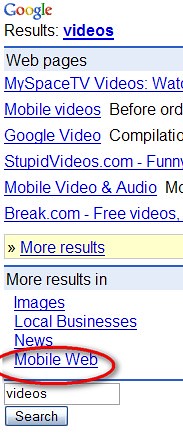
Google Mobile Search Update : Mobile Web Index Rescucitated

In march 2007, Google launched a new version of its mobile search engine, which quite looked like Yahoo OneSearch. The new version consisted of a page with just one search box, after entering a query, Google would automatically categorize search results in Web results, Local results, Images and News.

The only problem with this new version was that Google didn’t make a difference between full web pages and mobile pages. Pages from the Web and Mobile Web indices were mixed together, users couldn’t choose what kind of pages they wanted to have. For example, before that, if you couldn’t find pages that would display properly in the full Web index, you could use the Mobile Web index and find only pages adapted to your mobile.

At the time, I explained all the issues of the new Google Mobile in that post. Several people involved in mobile Web complained about the change. I even sent several emails to some people at Google in order to ask them to bring the Mobile Web index back. Well, it looks like Google heard us. The Mobile Web Index is back on Google Mobile Search engine.
If  you go to Google Mobile and search for something, you’ll now have 5 kinds of results: Web, Images, Local, Business, News, and Mobile Web.

I’m glad Google decided to rescucitate the Mobile Web, because even if transcoded pages are great when browsing with a handheld device, they cannot replace sites created specifically for the small screen.

Google Partners with NTT DoCoMo on Mobile Search

NTT DoCoMo, Japan’s biggest mobile carrier has announced that it has partnered with Google to provide their services on their Internet portal.

This is the second deal that Google signs with a Japanese carrier, the first one was with KDDI, Japan’s No. 2 mobile phone company , a couple of months ago.

DoCoMo and KDDI together control over 80 percent of Japan’s mobile market, so these deals will allow Google to gain lots of mobile search users.

Yahoo! is still Japan’s number 1 search engine, so Google can reverse the situation on the mobile search market.

KDDI and DoCoMo are both part of the Open Handset Alliance, the group behind Android, so that explains why they chose Google as their mobile search provider. The two companies will soon launch handsets running on this new mobile OS.

Source : Reuters.

Google Sees Surge Of Traffic From iPhones

According to the NYT, traffic to Google from iPhones surged during Christmas, and has even surpassed traffic from any other type of mobile device. People love the web experience provided by the iPhone so much that they surf more than traditional mobile phone’s owners, for whom it’s still not that easy to go online.

“The data is striking because the iPhone, an Apple product, accounts for just 2 percent of smartphones worldwide, according to IDC, a market research firm. Phones powered by Symbian make up 63 percent of the worldwide smartphone market, while those powered by Microsoft’s Windows Mobile have 11 percent and those running the BlackBerry system have 10 percent.”

Other handset manufacturers should replicate this kind of experience to increase the number of people using the web on the go, and to help the mobile web truly take off.