Monthly Archives: March 2007

Mobile SEO: Google Has Killed the Mobile Web

Google launched its new mobile search engine a few days ago.I’ve blogged about it on this post and highlighted the main features.While I think the new user Interface is better than the last one, I’m really saddened (and annoyed) by the fact that Google doesn’t allow users to search inside their mobile web index.
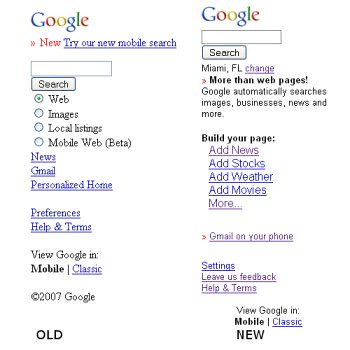
Instead, it has chosen to mix mobile web results with the regular web results depending on the users query. Google must think that because they transcode all pages, users will be happy with what will be displayed on their phones.

Google has probably analyzed the search behavior of mobile users, and depending on where they clicked (web or mobile results), they’ve now decided what to show to the user, without the need for them to select what kind of results they wanted to see.

So, that would mean that this new mobile search engine uses some sort of semantic technology…Yeah, right, the desktop engine is not a fully-fledged semantic search engine and Google wants us to believe that this is the case with the new mobile search engine.

So let’s see how good this new version is. Let’s say that I want to use Google on my phone to search for “ringtones”. With the new version of Google, we have these 6 results on the first page (I did this test with a SonyEricsson W600i):

1. http://www.ringophone.com: transcoded web page : Even if the page was taking so much time to load, I tried to make a purchase and on the next page, my phone displayed an error message saying that the “page was too large to load”

2. http://www.mtv.com/mobile/ringtones/: transcoded web page: Flash Site, unable to buy a ringtone (I got the “page too large to load” message)

3. http://en.wikipedia.org/wiki/Ringtones: transcoded web page, Wikipedia page

4. http://department.monm.edu/uptildawn/forum/00000b93.htm?ringtones: spam page

5. http://www.ringtonejukebox.com: transcoded web page, again, I’m unable to browse properly and to purchase a ringtone.

6. www.umes.edu/accsupport/ossd/ossdchat/0000008d.htm?ringtones: spam page linking to a page full of ads (not displayed on my phone)

If you click on the next pages, you’ll only get regular web pages and the user experience will be the same.

If users still had the ability to see only mobile pages, their experience would be better (not excellent though). These are the results you would get if you selected “Mobile Web” on the previous version of Google Mobile. You’ll find mobile sites that will display properly on your browser an that have a mobile specific payment solution, for example this site.

So, did Google just go out of its mind?Why did they abandon the mobile web as a source of results? Transcoding pages is not the best solution to ensure a good user experience. There are more and more mobile websites that are user friendly and Google’s just decided to burry them.

I’ve sent a feedback to Google and I hope they will bring back the “mobile web” soon, as I’m sure a lot of people are going to loose a lot of traffic because of that, and users won’t be satisfied either.

[UPDATE]If you are involved in the mobile web and don’t want to lose traffic, please consider leaving a feeback with the comment form on Google Mobile to bring back the mobile web as a separate source of results. Also, please read Dennis’ post on Wap Review  who also complains about this issue.

Microsoft Launch New Mobile Browser (beta)

Microsoft Live Labs just announced that their new mobile browser was now available as a beta version. The browser is called Deepfish (the blue fish is really cool!), and is basically capable of displaying any desktop website.

“The Deepfish Technology Preview enhances existing mobile browsing technologies by displaying content in a view that is closer to the desktop experience. Our zoom-able interface and cue map allow you to quickly access the information you care about over the web without ever losing track of where you are. ”

The browser allows you to zoom in and out, which seems like a pretty nice feature. I’ve seen that kind of feature on a Nokia e50 as well.

I’ve tried to download it but I guess they already ran out of invites…

Via Opera Watch and Cre8asiteforums.

LG To Install Google on Millions of Phones

Google just reached a deal with mobile manufacturer LG to pre-install its search engine and other services on millions of mobile phones.

“Selected LG handsets, pre-installed with Google products and services, will be shipped globally in the second quarter. They will offer one-click access to Google’s search engine as well as Google maps, Gmail and Blogger Mobile.”

This deal is similar to the one Google signed with Samsung in January.

With that kind of pact, Google’s market share in the mobile search arena is just going to increase even more.

Google Launches New Mobile Search Engine!

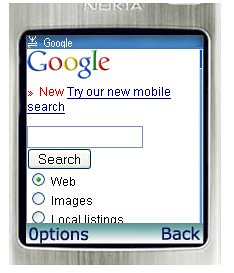
Google just launched its new mobile search engine in reply to Yahoo!’s OneSearch. If you go to the mobile version of Google, you’ll see this message:

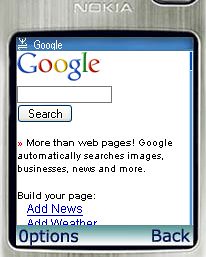
This is what the new homepage looks like :

It’s just one search box. Users need to type in their query, and Google will automatically categorize them in “Web results”, “Images”, “News”, “Local results” etc.

For example, if I search for “britney”, Google will show images of the pop star first:

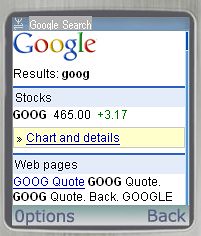
If the user searches information about a company and searches for a ticker, it will display this:

In this new version of Google, web results and mobile results are not separated, but mixed together. Google seems to be choosing which result (from their web index or their mobile index) to show depending on the search query.

This is what they say about this on their help page:

Google mobile web search can display different types of web sites:
– Webpages specifically designed for mobile devices will be displayed as is, and are identified by a phone icon.
– Webpages not specifically designed for mobile devices will be formatted by Google so that the pages will display on your mobile device. During this process, Google analyzes the original HTML code to get a sense for the page layout. In order to ensure that the highest quality and most useful web page is displayed on your mobile device, Google may alter images, text formatting and/or certain aspects of web page functionality to make it suitable for viewing on your device.

Users also have the ability to build their own mobile homepage, in order to add news, weather, Slashdot feeds etc:

It only took a few days for Google to reply to Yahoo! in the mobile search battle. We yet have to hear an announcement from Google to see if this is a beta version or not. I guess it’s now Google’s turn to compare itself against Yahoo! 🙂

UPDATE: A post has just been posted on the Official Google Blog to announce the new mobile search engine.

Yahoo! Is Really Getting Serious About Mobile Search

Last week, Yahoo! proudly announced that their mobile search service (downloadable application) called OneSearch was now available on more than 85% of US phones.

In the meantime, they also wanted to show everyone how good OneSearch was, by comparing it with Google. A report called “Dare to Compare” is linked from their homepage and is available there .

After showing off its new mobile search engine, Yahoo! now announces the launch of its Mobile Publish Services, “a suite of services designed to enable publishers to increase the discovery, distribution and monetization of their content on mobile phones”. These services will be available on this website (nothing there yet).

This is good news for advertisers wanting to reach more customers through mobile devices.

Here are the new services that publishers will have access to in the 2nd quarter of 2007 and in 19 countries:

Yahoo! Mobile Ad Network

The Yahoo! Mobile Ad Network will allow mobile publishers to have syndicated advertising served on their mobile content and services. Publishers will be able to select the ad formats they want to have run, such as display, sponsored links, video or in-game placements.

Yahoo! Mobile Content Engine

The Yahoo! Mobile Content Engine will enable publishers to bring their content to Yahoo!’s mobile audience. It will also help enable publishers who do not have a mobile site or only have a limited mobile offering to quickly distribute their content to consumers on their mobile phones.

Yahoo! Mobile Media Directory

The Yahoo! Mobile Media Directory will allow publishers to make their mobile media content accessible directly through Yahoo! oneSearch. Publishers could submit a catalog of their content such as ringtones, games, video and applications.

Let’s break these walled gardens! Yahoo will now allow users to search for mobile content outside of their operator’s Wap portal.

Yahoo! Mobile Site Submit

The Yahoo! Mobile Site Submit will allow publishers to provide information about their mobile site, such as a description and relevant tags, to ensure that their sites are accurately indexed and available to consumers through Yahoo! oneSearch. For example, a hotel could submit their mobile site, including description and tag, enabling weekend travelers to find their location and see if they still have rooms available through Yahoo! oneSearch.

I don’t know what they mean with “tags”. Maybe they will allow people to submit XML feeds of their content, with something similar to Google Base.

With all these new services, Yahoo! is really showing everyone that they’re serious about mobile search. Google might be very quiet at the moment, but you can expect them to get more aggressive as well in the next few months.

Google’s K-1 Report Reveals a Few Mobile Search Tidbits

Via John Battelle’s blog, I’ve learned that Google filled its K1-form this week. I wanted to see what Google had to say about Mobile Search in this report and found a few interesing tidbits.

Obviously, Google is underling the fact that mobile phones represents a fundamental development platform:

Mobile phones are a fundamental development platform for us. Many people around the world have their first experience of the internet—and Google—on their mobile phones. We have continued to invest in improving mobile search and have introduced applications that allow users to access search, email, maps, directions and satellite imagery through their mobile devices.

About “the first experience of internet on mobile phones”, this is one of the reasons why Google is trying to expand in third-world countries, where people have access to mobile phones but not to computers. For example, they are willing to buy Portugal Telecom in order to gain users in former five Portugese colonies such as Angola or Cape Verde.

Regarding mobile search ads, Google reports that they have been testing ad placements, but don’t really explain what they have planned for the future. I know that Google Adwords for mobile is live in the US, France, UK, and Germany but am not sure about other countries where it’s (or will be) available.

Hey Yahoo and Live: My Site Already Links to Its Mobile Version, So Please Don’t Transcode It!

When you are using a traditional search engine on your mobile, it will transcode the pages automatically so that it can be displayed properly on your browser. This is done by using proxies. Google, Yahoo!, and Live Search are all providing this functionality. For example, if you use Google on your mobile, and choose to see “Web Results”, the page you’ll be viewing will look like this.

If you do have a mobile friendly version of your site, you can tell Google and others search engines not to transcode your page and to direct users to your mobile site instead.

This can be achieved by simply adding this link element in the head of your pages:

<link rel=“alternate” media=“handheld” href=“http://www.yourmobilesite.com/” />

Now, while Google does follow this link and skip the transcoding, I’ve noticed that Yahoo! and Live are behaving differently. For example, if you use Live Search on your mobile, all the results will be showed from a proxy server ( notice that urls start with http://mobrender.com/proxy.aspx?s.) whether you’ve specified a link to the mobile version of your site or not.

What annoys me is that some sites that I manage do have the link element to their mobile versions, but both Live Search and Yahoo aren’t supporting that. Instead, they will force the transcoding. I’ve tested that with many handsets, either XHTML or WML capable, but it was always the same. I’ve notified Yahoo! about this problem but they haven’t got back to me yet. I will also let Microsoft know about that. If you know of other ways to tell them not to use transcoding proxies, please let me know.

UPDATE: (03/06/07) I’ve received a response from someone at Yahoo! who told me that they are investigating this issue.